
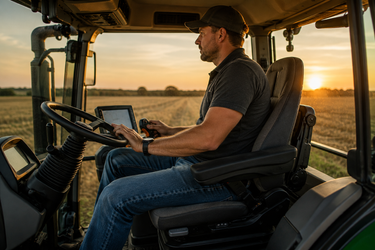
How Tractor Seats Affect Operator Fatigue and Productivity
Yes, tractor seats can significantly affect both operator fatigue and productivity. A poorly designed or worn seat may increase vibration exposure, reduce posture support, and force operators to constantly adjust their body position throughout the day. Over time, these factors can contribute to tractor operator fatigue, reduced concentration, and lower work efficiency.
Modern agricultural operations often require operators to spend several consecutive hours in the cab. While engine performance and machine capabilities receive significant attention, tractor seat comfort is frequently overlooked. However, research related to agricultural ergonomics and whole-body vibration (WBV) has consistently shown that seating quality plays an important role in operator well-being and job performance.
Understanding how tractor seats affect fatigue can help equipment owners make better decisions when selecting, upgrading, or replacing their seating systems.
Why Do Tractor Operators Experience Fatigue?
Operator fatigue rarely has a single cause. Instead, it typically develops through a combination of physical and environmental factors that accumulate throughout the workday.
| Fatigue Factor | How It Affects Operators |
|---|---|
| Long operating hours | Increases physical and mental strain over extended shifts |
| Repetitive vibration exposure | Contributes to discomfort and whole-body fatigue |
| Poor posture support | Places additional stress on the back, neck, and shoulders |
| Uneven terrain | Creates continuous impacts that increase fatigue |
| Constant body movement | Requires ongoing muscle engagement throughout operation |
Long Operating Hours
Many operators spend six to ten hours or more in a tractor during planting, harvesting, mowing, and maintenance activities. Extended periods of sitting can gradually increase physical strain, especially when seat support and vibration control are inadequate.
Repetitive Vibration Exposure
Agricultural equipment generates constant vibration during operation. Uneven terrain, engine movement, and implement interaction all contribute to vibration levels experienced by the operator.
Repeated vibration exposure is one of the primary contributors to tractor operator fatigue. Over time, excessive vibration may affect comfort, concentration, and overall physical endurance.
Poor Posture Support
When a seat fails to support the lower back and natural spinal alignment, operators often compensate by adjusting their posture throughout the day.
These constant adjustments increase muscle strain and can contribute to discomfort in the shoulders, neck, and lower back.
This is one reason why tractor seat ergonomics has become an increasingly important consideration in modern agricultural equipment design.
Uneven Terrain
Fields, orchards, construction sites, and rural properties rarely provide perfectly smooth operating surfaces.
The rougher the terrain, the harder the seat must work to isolate the operator from impacts and vibration. Poor suspension performance often becomes more noticeable in challenging environments.
Constant Body Movement
Operators frequently turn, reach, monitor implements, and perform repetitive movements while working.
When seat support is inadequate, these movements require more physical effort, increasing fatigue over long operating periods.
How Tractor Seats Contribute to Whole-Body Vibration
Whole-body vibration refers to mechanical vibration transmitted through a seated operator's body while operating machinery.
The International Organization for Standardization (ISO) has established standards such as ISO 2631 for evaluating human exposure to whole-body vibration. While vibration levels vary significantly depending on equipment type, operating speed, terrain conditions, and seat design, reducing vibration exposure is widely recognized as an important factor in improving operator comfort and reducing fatigue.
According to occupational health and agricultural ergonomics research, prolonged exposure to WBV has been associated with discomfort, fatigue, and musculoskeletal stress. While vibration levels vary depending on equipment type and terrain conditions, seating systems play a critical role in managing vibration exposure.
A tractor seat serves as the primary interface between the machine and the operator. When the suspension system, cushioning, or seat structure cannot effectively absorb vibration, more energy is transferred directly to the body.
The impact becomes especially noticeable during:
- Field preparation
- Tillage operations
- Mowing uneven ground
- Transporting loads across rough surfaces
- Long-distance equipment operation
A well-designed suspension seat helps minimize vibration transfer and supports improved operator comfort during demanding tasks.
How Poor Seating Can Reduce Productivity
Many equipment owners focus on machine horsepower, fuel efficiency, and implement performance when evaluating productivity. However, can tractor seats affect productivity? In many situations, the answer is yes.
Productivity is closely connected to operator comfort and concentration. As fatigue increases, attention levels may decline and physical discomfort can make routine tasks more difficult.
Poor seating conditions may contribute to:
| Fatigue-Related Issue | Possible Operational Impact |
|---|---|
| Reduced concentration | Increased risk of errors |
| Lower energy levels | Slower task completion |
| Back and shoulder discomfort | More frequent breaks |
| Excessive vibration exposure | Reduced operator endurance |
| Poor seating posture | Lower overall productivity |
These effects may seem minor individually, but they can accumulate throughout long workdays and busy agricultural seasons.
For businesses operating multiple machines, improving tractor seat comfort may support better operator performance and potentially reduce fatigue-related complaints.
Which Tractor Seat Features Help Reduce Fatigue?
Not all seats provide the same level of support. Several design features can significantly improve tractor seat ergonomics and help reduce fatigue during daily operation.
| Seat Feature | Primary Benefit |
|---|---|
| Suspension System | Reduces vibration exposure |
| Lumbar Support | Supports natural spinal alignment |
| Adjustable Backrest | Improves seating posture |
| Weight Adjustment | Optimizes suspension performance |
| Seat Cushioning | Reduces pressure points during long use |
| Armrests | Lowers shoulder and upper-body strain |
| Shock Absorption | Minimizes impact from uneven terrain |
In practice, operators often notice fatigue-related improvements only after replacing a worn or outdated seat. While engine performance and machine capability remain unchanged, improved seating support can make long working days feel noticeably less demanding, particularly when operating on uneven terrain or during seasonal peak workloads.
Suspension Systems
Suspension systems are among the most important fatigue-reduction features.
Mechanical suspension and air suspension systems both help absorb vibration before it reaches the operator. The appropriate choice depends on workload, terrain conditions, and operating hours.
Lumbar Support
Proper lumbar support helps maintain natural spinal alignment and reduces pressure on the lower back.
This feature becomes increasingly important for operators who spend extended periods in the seat each day.
Adjustable Backrests
Adjustable backrests allow operators to customize seating posture according to their body type and working preferences.
Improved positioning often contributes to better comfort and reduced muscle strain.
Weight Adjustment
Different operators require different suspension settings.
Weight-adjustable suspension systems help optimize vibration absorption and maintain consistent support across varying operator sizes.
Seat Cushioning
High-density foam and multi-layer cushioning materials can improve pressure distribution across the seat surface.
Effective cushioning helps maintain tractor seat comfort during long operating sessions without excessive compression.
Armrests
Armrests help support the upper body and reduce shoulder fatigue during repetitive steering and control operations.
For many operators, armrests contribute significantly to overall seating comfort.
Shock Absorption
Modern seating systems often incorporate additional shock-absorption components that help manage sudden impacts generated by rough terrain.
Combined with suspension systems, these features improve ride quality and reduce vibration exposure.
Signs Your Tractor Seat May Be Contributing to Fatigue
Because fatigue develops gradually, many operators do not immediately recognize the seat as the source of the problem.
Several warning signs may indicate that the seating system is no longer providing adequate support.
Persistent Discomfort After Short Operating Periods
If discomfort develops within the first hour or two of operation, the seat may no longer be providing sufficient cushioning or support.
Increased Lower Back or Shoulder Strain
Frequent soreness after routine tasks often indicates inadequate ergonomic support.
Constant Position Adjustments
Operators who continuously shift positions may be attempting to compensate for poor seat design or worn components.
Excessive Vibration Felt Through the Seat
When vibration becomes increasingly noticeable, the suspension system or cushioning may no longer be performing effectively.
Reduced Comfort Compared to Previous Seasons
Gradual wear can be difficult to notice until operators compare current comfort levels with previous years of operation.
If multiple signs appear simultaneously, it may be time to evaluate whether the seat should be repaired, upgraded, or replaced.
Conclusion
Understanding how tractor seats affect fatigue is essential for both individual operators and equipment managers. Tractor operator fatigue is often influenced by vibration exposure, posture support, seating quality, and working conditions. Investing in better tractor seat ergonomics can help improve comfort, reduce physical strain, and support more productive operation throughout the workday.
For operators seeking durable seating solutions designed for agricultural and heavy-equipment environments, manufacturers such as Lumina offer suspension seating options focused on comfort, adjustability, and long-term reliability, helping reduce fatigue while supporting everyday productivity.