
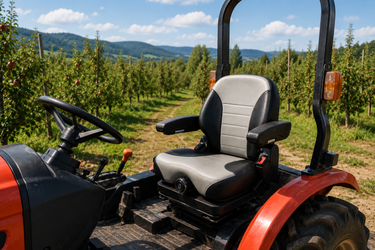
Air Suspension vs Mechanical Suspension Tractor Seats: Which Is Better for Your Work?
If you're comparing an air suspension tractor seat and a mechanical suspension tractor seat, the answer isn't simply that one is better than the other. The best choice depends on your operating conditions, working hours, equipment type, and budget.
For operators working long days on rough terrain, an air suspension tractor seat often provides better vibration isolation and ride comfort. For lighter-duty applications or budget-conscious buyers, a mechanical suspension tractor seat may offer the right balance of durability, comfort, and affordability.
Understanding the differences between these two suspension systems can help you make a smarter purchasing decision and avoid paying for features that don't match your actual workload.
What Is a Mechanical Suspension Tractor Seat?
A mechanical suspension tractor seat uses springs, shock absorbers, gas struts, or linkage systems to reduce the impact of bumps and vibration generated by the machine.
When a tractor travels across uneven terrain, the suspension mechanism compresses and rebounds to absorb some of the movement before it reaches the operator.
Because of their simple design, mechanical suspension systems have been widely used in agricultural equipment for decades. Modern models often include adjustable weight settings, sliding rails, reclining backrests, and armrests to improve comfort.
A quality mechanical suspension tractor seat is often sufficient for general farming, landscaping, mowing, and property maintenance applications where vibration exposure is moderate.
Another advantage is durability. With fewer complex components, mechanical suspension systems are often easier to maintain and repair over time.
What Is an Air Suspension Tractor Seat?
An air suspension tractor seat uses compressed air to support the operator and absorb vibration more dynamically.
Instead of relying primarily on springs, the suspension system adjusts through an air chamber that responds to changes in weight and terrain conditions.
Many air suspension seats allow operators to fine-tune ride characteristics according to their weight and personal preferences. Some premium systems even adjust automatically.
Because of this flexibility, air suspension tractor seats are commonly found in commercial farming operations, construction machinery, and heavy-duty equipment where operators spend long hours behind the wheel.
The primary goal is to reduce vibration exposure and improve comfort during extended operation.
What's the Differences Between Air Suspension and Mechanical Suspension Seats?
When evaluating air suspension vs mechanical suspension tractor seat options, buyers typically focus on comfort, maintenance, durability, and cost.
The table below highlights the key differences.
| Feature | Air Suspension Tractor Seat | Mechanical Suspension Tractor Seat |
|---|---|---|
| Suspension Method | Uses compressed air to absorb shock and vibration | Uses springs, shock absorbers, or gas struts |
| Ride Comfort | Smoother ride on rough terrain and during long workdays | Provides stable support but typically feels firmer |
| Vibration Reduction | Excellent vibration isolation | Good vibration reduction for most agricultural tasks |
| Weight Adjustment | Often self-adjusting or finely adjustable | Usually manual adjustment within a weight range |
| Maintenance Requirements | More components may require periodic inspection | Simpler design with lower maintenance needs |
| Initial Cost | Higher purchase price | More budget-friendly |
| Durability | Durable when maintained properly | Extremely robust and reliable in harsh environments |
| Best For | Long operating hours, rough terrain, heavy equipment | General farming, landscaping, light-to-medium-duty work |
| Operator Sharing | Easier to accommodate multiple operators | May require manual readjustment between users |
The air suspension vs mechanical suspension tractor seat debate often centers on comfort. However, the best choice usually depends on how the equipment is used rather than which technology sounds more advanced.
For some operators, a well-designed mechanical suspension tractor seat delivers everything they need. Others may find that the additional comfort of air suspension significantly improves their daily experience.
Which Suspension Type Matches Your Daily Work?
Choosing the right suspension system becomes easier when evaluating real-world operating conditions.
The following recommendations can help narrow down the most suitable option.
| Work Scenario | Recommended Suspension Type | Why |
|---|---|---|
| Rough terrain | Air Suspension | Better vibration isolation on uneven ground |
| Long daily operating hours | Air Suspension | Helps reduce fatigue during extended shifts |
| Budget-conscious applications | Mechanical Suspension | Lower initial cost and simple maintenance |
| Light-duty property maintenance | Mechanical Suspension | Provides sufficient comfort without unnecessary expense |
| Heavy agricultural machinery | Air Suspension | Improves comfort under high vibration conditions |
| Shared equipment with multiple operators | Air Suspension | Easier adjustment for different users |
Rough Terrain
Operators working in rocky fields, orchards, uneven farmland, or construction sites often experience significant vibration exposure.
In these situations, an air suspension tractor seat typically provides superior ride quality because the suspension reacts more smoothly to continuous impacts.
For machines operating daily on rough ground, the comfort difference can become noticeable over time.
Long Working Hours
When operators spend six to ten hours per day in a tractor, seat quality becomes increasingly important.
Studies related to agricultural ergonomics have shown that prolonged exposure to vibration may contribute to fatigue and physical discomfort. While no seat can eliminate vibration entirely, an air suspension tractor seat can help reduce its impact during long shifts.
Budget-Conscious Operations
Not every application requires premium suspension technology.
For occasional mowing, landscaping, hobby farming, and light agricultural work, a mechanical suspension tractor seat often delivers excellent value.
Many operators find that a quality mechanical system provides sufficient comfort without the additional expense of air suspension.
Heavy Equipment Applications
Large tractors, loaders, excavators, and industrial machines generate higher vibration levels than compact utility equipment.
In these environments, upgrading to an air suspension tractor seat may improve operator comfort, particularly during repetitive tasks and extended workdays.
When Is Upgrading to an Air Suspension Seat Actually Worth It?
Many buyers automatically assume that air suspension is the best option available. However, upgrading only makes sense when the benefits align with your actual working conditions.
An air suspension tractor seat is often worth considering when:
- You regularly operate equipment for more than six hours per day
- Your work involves rough terrain or uneven ground
- Operator fatigue is becoming a productivity concern
- Multiple operators share the same machine
- Comfort and vibration reduction are priorities
On the other hand, a mechanical suspension tractor seat may be the smarter investment when:
- Equipment is used occasionally
- Operating conditions are relatively smooth
- Budget is limited
- Simplicity and reliability are more important than premium comfort
The goal is not to purchase the most expensive seat available. The goal is to choose a suspension system that matches the demands of your daily work.
Conclusion
When comparing air suspension vs mechanical suspension tractor seat options, there is no one-size-fits-all answer. Air suspension generally offers superior vibration isolation and long-hour comfort, while mechanical suspension provides dependable performance, durability, and lower ownership costs.
For operators looking to upgrade agricultural or heavy equipment seating, it is worth focusing on fitment, suspension quality, durability, and operator needs rather than price alone. Manufacturers such as Lumina offer suspension seat solutions designed for tractors and other heavy machinery, helping operators achieve a practical balance between comfort, reliability, and long-term value.